The psilocybin mushrooms named in the Pacific Northwest
Of the 12 psilocybin species and varieties in this entry, 8 have type localities in Washington, Oregon or British Columbia, and two trace to the University of Washington campus in Seattle. Deadly amatoxin mushrooms occur in the same region, so this entry is naming history only, not a guide to picking.
From the shop our team runs, My Mushroom Dispensary. Adults 21+ only.
The short answer
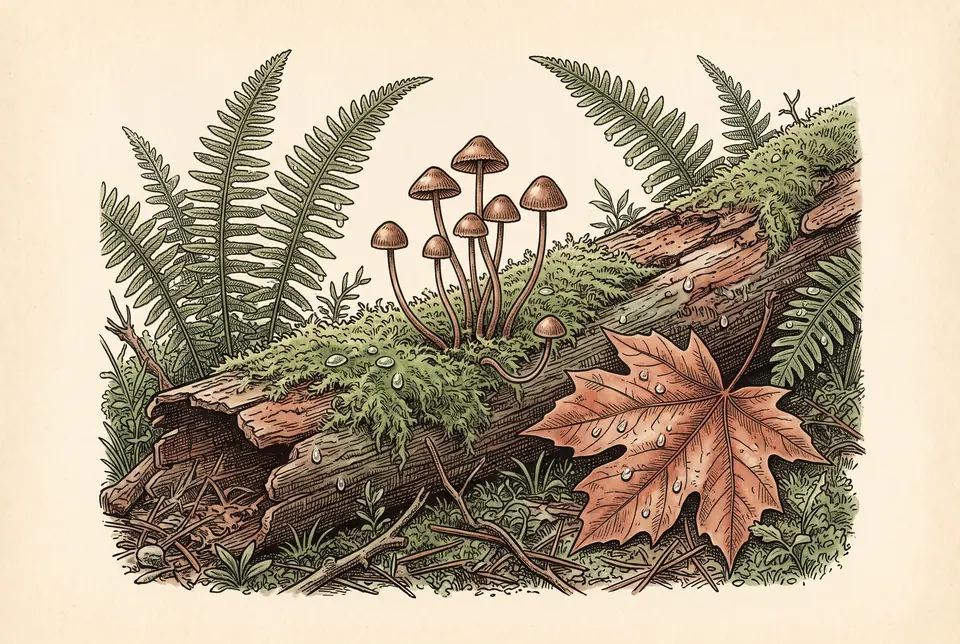
The Pacific Northwest has an unusual place in the naming of psilocybin mushrooms. Of the 12 psilocybin species and varieties in this entry's dataset, 8 have type localities in Washington, Oregon or British Columbia. Two trace to the University of Washington campus in Seattle: Psilocybe stuntzii, named in 1976 for UW botanist Daniel E. Stuntz, who collected its type there,1 and Psilocybe allenii, named in 2012, whose type material is labeled at a University of British Columbia herbarium as collected on the same campus.415 Deadly amatoxin mushrooms occur in the same region, and the Washington Poison Center warns that with wild mushrooms "even the experts can be fooled".713
This entry is naming history: who named each species, when, and where the type came from, no finer than a city, campus or county. It has no identification features, habitats or seasons, for reasons set out below.
Why the Northwest matters to mycology
Daniel E. Stuntz (1909 to 1983) earned his B.S. at the University of Washington in 1935 and his Ph.D. at Yale in 1940, was UW's Professor of Botany until his death, and helped establish the university's herbarium, WTU.17 In 1964 he helped found the Puget Sound Mycological Society (PSMS) with a small group that included Dixie Lee Ray, then director of the Pacific Science Center, and Ben Woo.16 WTU holds the holotype of P. stuntzii, the specimen the name is permanently tied to.1
The Evergreen State College in Olympia was a second center. Jerry Boydston of Evergreen co-wrote a 1976 survey of the region's psychoactive mushrooms with Gastón Guzmán, Jonathan Ott and Steven H. Pollock.2 In 1980 three Evergreen authors, Paul E. Stamets, Michael W. Beug and Jeremy E. Bigwood, described Psilocybe cyanofibrillosa with Guzmán and detected psilocybin and psilocin in their collections by liquid chromatography.3 Beug later chaired the Toxicology Committee of the North American Mycological Association (NAMA).14
Amateurs mattered too. The Key Council of the Pacific Northwest formed in 1974 to supply usable descriptions of regional mushrooms missing from the handbooks of the day, Kit Scates wrote in the PSMS newsletter in 1976.18 About 120 people attended the First Psychotropic Mushroom Foray, held at a Washington state park in 1976, where R. Gordon Wasson spoke.19 More than 260 registered for the Second International Conference on Hallucinogenic Mushrooms in Port Townsend in 1977, organized by Ott and Preston Wheaton of Olympia; Wasson, Albert Hofmann and Richard Evans Schultes spoke, and federal drug agents attended.20 The history and the timeline tell the wider story.
The species, by the date they were named
The 12 psilocybin species and varieties are listed by the year of the name as cited, then the two deadly lookalikes. Each entry gives the author citation, publication, type locality where recorded, regional connection and one source. The Northwest count above uses the location Index Fungorum gives for each name, or for the earlier name it is based on, and counts the 1980 variety by its own type. Herbarium counts reflect the names specimens were filed under on the date checked.
-
Psilocybe semilanceata(Fr.) P. Kumm. 1871
- Called
- Liberty Caps, a name 1970s users in western Washington gave to this species and Psilocybe pelliculosa alike (Guzmán, Ott, Boydston and Pollock 1976)
- Described in
- Kummer, Der Führer in die Pilzkunde: 71 (1871). Basionym Agaricus semilanceatus Fr., Observationes Mycologicae 2: 178 (1818).
- Type locality
- Europe (Index Fungorum gives Sweden for the basionym)
- Northwest connection
- Guzmán, Ott, Boydston and Pollock (1976) wrote that it was 'here reported from Washington for the first time', that recreational users in western Washington called it and P. pelliculosa by one name, Liberty Caps, and that the presence of psilocybin in it had been demonstrated.
-
Panaeolus cinctulus(Bolton) Sacc. 1887
- Described in
- Saccardo, Sylloge Fungorum 5: 1124 (1887). Basionym Agaricus cinctulus Bolton, Hist. Fung. Halifax 3: 152 (dated 1791, published 1792). Index Fungorum also lists Panaeolus subbalteatus (Berk. & Broome) Sacc. 1887 as a separate current name. A 2022 study notes that P. cinctulus is 'referred to as Panaeolus subbalteatus in many previous studies' (Gotvaldová et al., Int J Mol Sci 23(22): 14068, PMID 36430546).
- Type locality
- Great Britain (Index Fungorum, for the basionym)
- Northwest connection
- Reported in 1976, under the name Panaeolus subbalteatus, as used as a recreational drug 'in various parts of Washington'; the same paper noted that it had been described as 'psilocybian'.
-
Psilocybe cyanescensWakefield 1946
- Described in
- In Dennis & Wakefield, Transactions of the British Mycological Society 29(3): 141-166 (name on p. 141), 1946. doi:10.1016/S0007-1536(46)80038-X. An epitype from Germany was designated in 2012 (Czech Mycology 64(2): 193).
- Type locality
- Great Britain (holotype K(M) 63976)
- Northwest connection
- Guzmán, Ott, Boydston and Pollock (1976) reported it from Washington and wrote that it 'has lately begun to be used for its psychotropic effects'.
-
Gymnopilus aeruginosus(Peck) Singer 1951
- Described in
- Singer, Lilloa 22: 560 (volume dated 1949, published 1951). Basionym Pholiota aeruginosa Peck, Annual Report of the New York State Museum 43: 81 (1890).
- Type locality
- Pennsylvania, USA (type of the basionym)
- Northwest connection
- Hatfield and Valdes (1978, Lloydia 41(2): 140-144, PMID 565861) detected psilocybin in it, in what they called the first report of psilocybin from the genus. The Consortium of Pacific Northwest Herbaria database lists five Washington specimens filed under this name, the earliest from 1980 (queried November 2, 2026).
-
Psilocybe baeocystisSinger & A.H. Sm. 1958
- Described in
- Mycologia 50(1): 141, 1958. doi:10.2307/3756045.
- Type locality
- Oregon (Index Fungorum; holotype MICH, collected by Sipe, 1945)
- Northwest connection
- Robert G. Benedict, Lynn R. Brady and Varro E. Tyler Jr. reported psilocin in it in 1962 (J Pharm Sci 51: 393-394, PMID 13867140). Brady was at the University of Washington School of Pharmacy by 1976, according to the Puget Sound Mycological Society's newsletter.
-
Psilocybe pelliculosa(A.H. Sm.) Singer & A.H. Sm. 1958
- Called
- Liberty Caps, shared with Psilocybe semilanceata in 1970s western Washington usage (Guzmán, Ott, Boydston and Pollock 1976)
- Described in
- Mycologia 50(2): 262-303 (combination on p. 280), 1958. doi:10.1080/00275514.1958.12024726. Basionym Psathyra pelliculosa A.H. Sm., Mycologia 29(1): 45-59 (p. 58), 1937. doi:10.1080/00275514.1937.12017177.
- Type locality
- Oregon (type of the basionym, A. H. Smith 3431, MICH)
- Northwest connection
- Guzmán, Ott, Boydston and Pollock (1976) named it and P. semilanceata as the two hallucinogenic species 'widely consumed throughout western Washington' under the name Liberty Caps.
-
Psilocybe stuntziiGuzmán & Ott 1976
- Called
- Washington Blue Veil (reported by Weil 1977, Botanical Museum Leaflets, Harvard University 25(5): 131-149)
- Described in
- Mycologia 68(6): 1261-1267, issue dated November-December 1976; Index Fungorum gives 1977 as the actual year of publication. doi:10.1080/00275514.1976.12020019. PMID 1034878.
- Type locality
- University of Washington campus, Seattle (holotype WTU, collected by D. E. Stuntz, 1973)
- Northwest connection
- Named 'in honor of Dr. Daniel E. Stuntz, Professor of Botany at the University of Washington in Seattle'. The holotype is held at the University of Washington herbarium (WTU), now part of the Burke Museum.
-
Psilocybe subfimetariaGuzmán & A.H. Sm. 1978
- Described in
- Mycotaxon 7(3): 515-520 (name on p. 518), October-December 1978. doi:10.5962/p.417878.
- Type locality
- Vancouver, British Columbia (holotype ENCB, Guzmán 16677, 1976)
- Northwest connection
- One of three Psilocybe species Guzmán and Alexander H. Smith described in 1978 as new from the Pacific Northwest; the description reports psilocybin in it.
-
Psilocybe cyanofibrillosaGuzmán & Stamets 1980
- Described in
- In Stamets, Beug, Bigwood & Guzmán, Mycotaxon 11(2): 476-484 (name on p. 477), July-September 1980. doi:10.5962/p.417274.
- Type locality
- South King County, Washington (holotype ENCB, Stamets 79-8)
- Northwest connection
- Described from Washington by Paul E. Stamets, Michael W. Beug and Jeremy E. Bigwood, all listed at The Evergreen State College in Olympia, with Gastón Guzmán. The authors detected psilocybin and psilocin in it.
-
Psilocybe liniformans var. americanaGuzmán & Stamets 1980
- Described in
- In Stamets, Beug, Bigwood & Guzmán, Mycotaxon 11(2): 476-484 (variety on p. 480), 1980. doi:10.5962/p.417274. Index Fungorum now places it under Psilocybe liniformans Guzmán & Bas 1977.
- Type locality
- Thurston County (Olympia), Washington (type ENCB, Stamets 79-12, 1979)
- Northwest connection
- Named in the same Evergreen State College paper as P. cyanofibrillosa; the authors detected psilocybin but no psilocin in it.
-
Psilocybe azurescensStamets & Gartz 1995
- Described in
- Integration 6: 21 (start page per Index Fungorum; the full page range was not verified), 1995.
- Type locality
- Oregon (Index Fungorum)
- Northwest connection
- Described by Paul Stamets, a co-author of the 1980 Evergreen State College paper above, with Jochen Gartz. Index Fungorum records the holotype at the University of Washington herbarium (WTU) in Seattle as a Stamets collection from 1993. The Consortium of Pacific Northwest Herbaria database instead marks a WTU specimen collected in Oregon in 1979 as the holotype (queried November 2, 2026). Both records put the holotype at WTU and the type in Oregon; which specimen is the holotype is unresolved.
-
Psilocybe alleniiBorovička, Rockefeller & P.G. Werner 2012
- Described in
- Czech Mycology 64(2): 181-195 (name on p. 184), published December 7, 2012. doi:10.33585/cmy.64207. The same paper designated an epitype for Psilocybe cyanescens.
- Type locality
- Washington, USA (Index Fungorum; holotype PRM 899876). An isotype at the University of British Columbia herbarium (UBC F023752) is labeled as collected on the University of Washington campus, Seattle, in 2009.
- Northwest connection
- The UBC isotype label gives the collector as 'W. Allen' and records 'Psilocybe cyanofriscosa, nom. prov.', a provisional name for the same material. The University of Washington herbarium (WTU) also lists a 2009 collection from the campus under this name, with the collector given as 'John A. Allen'; its record does not mark it as type material (both queried November 2, 2026 in the Consortium of Pacific Northwest Herbaria database). We couldn't read the 2012 paper, so this entry doesn't say whom the epithet honors.
-
Galerina marginata(Batsch) Kühner 1935
- Described in
- Kühner, Encyclopédie Mycologique 7: 225 (1935). Basionym Agaricus marginatus Batsch, Elenchus Fungorum: 207 (1789). Index Fungorum treats Galerina autumnalis as a synonym.
- Type locality
- Not recorded in Index Fungorum
- Northwest connection
- A deadly lookalike, not a psilocybin species: University of British Columbia researchers found amatoxins in all 24 samples of the G. marginata complex they tested from western British Columbia (Landry et al. 2021). NAMA's 2010 poisoning report describes a British Columbia case in which a person seeking a psilocybin mushroom apparently ate a Galerina mushroom instead.
-
Conocybe filaris(Fr.) Kühner 1935
- Described in
- Kühner, Encyclopédie Mycologique 7: 159 (1935). Basionym Agaricus togularis var. filaris Fr. (1884). Index Fungorum treats Pholiotina filaris (Fr.) Singer as a synonym and lists Conocybe rugosa (Pholiotina rugosa) as a separate species.
- Type locality
- Not recorded in Index Fungorum
- Northwest connection
- A deadly lookalike, not a psilocybin species: in 1975 a team that included University of Washington mycologist Daniel E. Stuntz identified it as a toxic mushroom (Brady et al., Lloydia 38(2): 172-173). Hallen, Watling and Adams (2003, PMID 14531619) state that amatoxins are present in it.
Download this data. Psilocybin mushroom species recorded in the Pacific Northwest: naming history, 14 rows, updated November 2, 2026. Free to reuse under CC BY 4.0 with a link to this page.
The names and the people behind them
Stuntz. Guzmán and Ott named Psilocybe stuntzii "in honor of Dr. Daniel E. Stuntz, Professor of Botany at the University of Washington in Seattle, in recognition of his valuable research in the field of mycology." They wrote that it "was first collected on the campus of the University of Washington"; Stuntz collected the holotype in 1973.1
Allen. An isotype of P. allenii at the University of British Columbia herbarium, a duplicate from the type collection, is labeled as collected on the UW campus in 2009 by "W. Allen", and the label records a provisional name for the same material, "Psilocybe cyanofriscosa".15 We couldn't read the 2012 paper that named the species, so this entry doesn't say whom the epithet honors.4
Puget Sound. One place name didn't survive. Guzmán and Ott wrote that "a fanciful book" had called the Seattle species "Psilocybe pugetensis (a nonexistent entity)", "thus introducing a spurious epithet to the literature", and that it had been misidentified as P. cyanescens in a 1975 article by Andrew Weil.1 More naming confusions are in myths checked.
Liberty Caps. The 1976 survey reported that users in western Washington called two species, P. semilanceata and P. pelliculosa, by one name, Liberty Caps, and reported P. semilanceata from Washington "for the first time". It also noted that Psilocybe angustispora, described from Washington, "is not known to be hallucinogenic", so it isn't in this dataset.2
The deadly lookalikes
For people picking wild mushrooms, mistaken identity can be fatal. Galerina marginata and Conocybe filaris contain amatoxins,67 the poisons in the death cap, Amanita phalloides, which stop liver cells from making proteins.8 In 1975 a team that included Stuntz identified Conocybe filaris as toxic.5 In 2021 University of British Columbia researchers found amatoxins in all 24 samples of the G. marginata complex they tested from western British Columbia, and called Galerina's roughly 300 species "notoriously difficult to identify by morphology".7
The poison works slowly. A 2017 report in the CDC's Morbidity and Mortality Weekly Report describes three phases: gastroenteritis, with vomiting and diarrhea, after a delay of 6 to 24 hours; an apparent recovery 24 to 36 hours after eating; then liver and multiorgan failure, typically 3 to 5 days after. In a 2016 Northern California cluster, 3 of 14 patients received liver transplants.8 NAMA's 2010 report describes a British Columbia case in which "a young man apparently picked and consumed some Galerina thinking he had Psilocybe", with fear of liver damage, and adds that "many years ago, a mistake like this cost another young person her life".14
If anyone has eaten a wild mushroom that an expert hasn't identified, call Poison Control at 1-800-222-1222 right away, even before symptoms start. A person can feel fine for hours. The Washington Poison Center answers 24/7 and asks people to call right away if nausea, vomiting or diarrhea starts.13 PSMS advises having the mushroom or a photo ready, and calling 911 for difficulty breathing, seizures or loss of consciousness.21
Picking is illegal and dangerous
Psilocybin and psilocin are Schedule I controlled substances under Washington and federal law, and both schedules cover "any material, compound, mixture, or preparation" containing any quantity of them,911 so a picked mushroom that contains psilocybin is a controlled substance. In Washington, knowingly possessing one is a gross misdemeanor. The statute's exceptions are for a valid prescription or practitioner's order and what the chapter otherwise authorizes, with none for a mushroom someone picked.10
Collecting rules exist too: Washington State Parks' harvest rule covers edible plants and mushrooms for personal use and doesn't make picking a controlled substance lawful.12 Arrests aren't new: in 1977 the PSMS board recorded a sample sent by the Lewis County Sheriff's Office after young people were arrested for trespassing with the mushrooms in their possession.20 For what Seattle's 2021 entheogen resolution does and doesn't change, see visiting Seattle. The medical danger is the deadly lookalikes above.
Why this entry has no identification guide
This almanac doesn't publish identification features, habitats, seasons or locations for any wild mushroom. The lookalikes above can kill, and the researchers who tested them call Galerina species hard to identify by form alone,7 so a written guide on a web page would add risk, not safety. To learn about mushrooms in person, the Puget Sound Mycological Society runs member classes, including one on mushroom identification.21
Questions people ask
Is there a psilocybin mushroom named after someone from Seattle?
Yes. Psilocybe stuntzii (1976) honors Daniel E. Stuntz, UW's Professor of Botany, and its type was collected on the UW campus. Psilocybe allenii (2012) also has type material labeled as collected on that campus, by a collector named Allen, but we couldn't read the paper that named it to confirm whom the name honors.
Is it legal to pick magic mushrooms in Washington?
No. Psilocybin and psilocin are Schedule I under Washington and federal law, and the schedules cover any material containing them, so a picked mushroom with psilocybin in it is a controlled substance. Knowing possession is a gross misdemeanor in Washington.
Can you tell a psilocybin mushroom from a deadly one by looking?
This almanac doesn't give identification features. Researchers call Galerina, a genus that includes amatoxin-carrying species, notoriously difficult to identify by form, and the Washington Poison Center warns that even experts can be fooled. If someone has eaten a wild mushroom, call Poison Control at 1-800-222-1222 right away.
What is a type locality?
The place where the specimen a scientific name is based on was collected. This entry gives it no finer than a city, campus or county.
Sources
- Guzmán G, Ott J. Description and chemical analysis of a new species of hallucinogenic Psilocybe from the Pacific Northwest. Mycologia 68(6): 1261-1267, November-December 1976. PMID 1034878.
- Guzmán G, Ott J, Boydston J, Pollock SH. Psychotropic mycoflora of Washington, Idaho, Oregon, California and British Columbia. Mycologia 68(6): 1267-1272, 1976.
- Stamets PE, Beug MW, Bigwood JE, Guzmán G. A new species and a new variety of Psilocybe from North America. Mycotaxon 11(2): 476-484, July-September 1980.
- Borovička J, Rockefeller A, Werner PG, 2012, the paper describing Psilocybe allenii. Czech Mycology 64(2): 181-195, December 7, 2012.
- Brady LR, Benedict RG, Tyler VE, Stuntz DE, Malone MH. Identification of Conocybe filaris as a toxic basidiomycete. Lloydia 38(2): 172-173, 1975. PMID 1169671.
- Hallen HE, Watling R, Adams GC. Taxonomy and toxicity of Conocybe lactea and related species. Mycological Research 107(8): 969-979, August 2003. PMID 14531619.
- Landry B, et al. Phylogenetic analysis of the distribution of deadly amatoxins among the little brown mushrooms of the genus Galerina. PLoS One 16(2): e0246575, February 10, 2021. PMID 33566818.
- Vo KT, et al. Amanita phalloides mushroom poisonings, Northern California, December 2016. CDC, MMWR 66(21): 549-553, June 2, 2017. PMID 28570504.
- RCW 69.50.204: Schedule I. Washington State Legislature, checked November 2, 2026.
- RCW 69.50.4013: Possession of controlled substance. Washington State Legislature, checked November 2, 2026.
- 21 CFR 1308.11: Schedule I. Electronic Code of Federal Regulations, text current to October 30, 2026, checked November 2, 2026.
- WAC 352-28-030: Harvest of edibles. Washington State Parks and Recreation Commission rule, effective March 9, 2008.
- A Mushroom PSA from our Fun-Guys and Gals. Washington Poison Center, July 23, 2025.
- Beug MW. NAMA Toxicology Committee Report for 2010. North American Mycological Association.
- Consortium of Pacific Northwest Herbaria, specimen database. UBC isotype (F023752) and WTU records of Psilocybe allenii, queried November 2, 2026.
- History, Mission, and Bylaws. Puget Sound Mycological Society, checked November 2, 2026.
- Daniel E. Stuntz Memorial Foundation. Puget Sound Mycological Society, checked November 2, 2026.
- Scates K. The Key Council of the Pacific Northwest. Spore Prints No. 121, Puget Sound Mycological Society, April 1976.
- Spore Prints No. 127. Puget Sound Mycological Society, December 1976 (foray report by Scott Chilton).
- Chilton S. Hallucinogenic mushroom conference; Board news. Spore Prints No. 138, Puget Sound Mycological Society, January 1978.
- Learn More About Mushrooms: classes and workshops. Puget Sound Mycological Society, checked November 2, 2026.
Related entries
 A history of magic mushrooms in SeattleFrom a 1964 mushroom society and a species named on the UW campus to the city and county votes of 2021 to 2026.
 Psilocybin in Seattle and Washington: a dated timeline, 1937 to 2026140 dated events from 1937 to 2026: the law, the science, the research and the culture, each with its source.
 Magic mushrooms in Seattle: myths checked against the recordEighteen claims about psilocybin in Seattle, each checked against statutes, council records and studies.
 Visiting Seattle: what the law says about magic mushroomsCannabis yes, psilocybin no: the law at Sea-Tac, on ferries, at the Canadian border, on Alaska cruises and in Oregon.
Compiled and checked by the Magic Mushrooms Seattle editors. Every fact on this page is dated and links to its source. Found an error? Tell us and we'll correct it in the open, as our editorial standards describe. Magic Mushrooms Seattle is published by the team that runs My Mushroom Dispensary, an online shop. We sell no advertising and nothing on this site.