Psilocybe stuntzii at 50: the species named for UW botanist Daniel Stuntz
Psilocybe stuntzii, described by Gastón Guzmán and Jonathan Ott in Mycologia's November to December 1976 issue, turns 50 this season, though Index Fungorum records that the issue actually appeared in 1977. The paper names the species for University of Washington botanist Daniel E. Stuntz, and its type specimen is held at the university's herbarium in Seattle.
From the shop our team runs, My Mushroom Dispensary. Adults 21+ only.
The paper, and a date that depends on how you count
In the November to December 1976 issue of Mycologia (volume 68, number 6, pages 1261 to 1267), Gastón Guzmán and Jonathan Ott published "Description and chemical analysis of a new species of hallucinogenic Psilocybe from the Pacific Northwest."1 The new species was Psilocybe stuntzii Guzmán & Ott. Guzmán was then at the Escuela Nacional de Ciencias Biológicas in Mexico City, and Ott at the Instituto de Investigaciones Biomédicas of the National Autonomous University of Mexico.2
Index Fungorum, the international names database, gives the "year on publication" as 1976 but the "year of publication" as 1977, meaning the issue came out after its cover date. It lists the name as legitimate and current, under record 321952.3 So the species turns 50 this season by the cover date, or in 2027 by the date the issue reached readers.
The paper's chemical analysis detected psilocybin. The authors didn't detect psilocin and wrote that this was likely due to the age of the specimens tested rather than to its absence from the species.2
The man it honors
The paper states the dedication in one sentence:
"Psilocybe stuntzii is named in honor of Dr. Daniel E. Stuntz, Professor of Botany at the University of Washington in Seattle, in recognition of his valuable research in the field of mycology."
Guzmán and Ott, Mycologia 68(6), 1976
Stuntz was born March 15, 1909, in Milford, Ohio. He earned a B.S. at the University of Washington in 1935 and a Ph.D. at Yale in 1940, and he was Professor of Botany at the UW until his death in 1983. The Puget Sound Mycological Society credits him with helping establish the university's herbarium.5 The society called him "Our founder and scientific adviser" when he died suddenly on March 5, 1983,7 and its December 1976 bulletin, the same issue that reported the 1976 mushroom meeting, lists him as scientific advisor.6
Stuntz also worked on mushroom poisoning and fielded the public's questions. In 1975 he co-wrote, with L. R. Brady, R. G. Benedict, V. E. Tyler and M. H. Malone, "Identification of Conocybe filaris as a toxic basidiomycete."9 In November 1977 the society's board heard that Stuntz had his assistants log the time they spent answering requests at the university to identify hallucinogenic mushrooms: "the equivalent of 40 hours per week since September."8
The type specimen in Seattle
A species name is anchored to a type, a preserved specimen that fixes what the name refers to. For P. stuntzii, the holotype was collected by Stuntz in 1973 and deposited at WTU,23 the herbarium of the University of Washington's Burke Museum in Seattle.4 Fifty years on, Index Fungorum still records the holotype at WTU.3
Both authors spoke at a Washington mushroom meeting over Halloween weekend 1976 (see Fifty years since the 1976 mushroom meeting).6 The almanac's wild species entry gives the naming history of this and other Northwest species, and the history and timeline place the 1970s in Washington's story.
What this post leaves out, and why
This post sticks to natural history. The almanac doesn't describe how to recognize this or any wild mushroom, or where and when it appears, because mistakes can kill. The Washington Poison Center warns that "Many toxic types look suspiciously like edible varieties, and even the experts can be fooled," and asks people to call 1-800-222-1222 right away if nausea, vomiting or diarrhea starts after eating a wild mushroom.10 Don't eat wild mushrooms you can't be certain of; deadly lookalikes turn up in the same places. In an emergency, call 911.
Sources
- Guzmán G, Ott J. Description and chemical analysis of a new species of hallucinogenic Psilocybe from the Pacific Northwest. Mycologia 68(6): 1261-1267, November to December 1976. PMID 1034878.
- Guzmán G, Ott J, 1976: full text of the species description. Mycologia 68(6): 1261-1267, via the MAPS Psychedelic Bibliography.
- Psilocybe stuntzii Guzmán & J. Ott, record 321952. Index Fungorum web service. Checked November 2, 2026.
- WTU Herbarium, University of Washington, Burke Museum. GBIF Registry of Scientific Collections.
- Daniel E. Stuntz Memorial Foundation: About Dr. Stuntz. Puget Sound Mycological Society.
- Bulletin of the Puget Sound Mycological Society, No. 127 (masthead and the report on the 1976 meeting). Puget Sound Mycological Society, December 1976.
- Bulletin of the Puget Sound Mycological Society, No. 191: In memoriam Daniel E. Stuntz, 1909 to 1983. Puget Sound Mycological Society, April 1983.
- Bulletin of the Puget Sound Mycological Society, No. 138: Board news, meeting of November 21, 1977. Puget Sound Mycological Society, January 1978.
- Brady LR, Benedict RG, Tyler VE, Stuntz DE, Malone MH. Identification of Conocybe filaris as a toxic basidiomycete. Lloydia 38(2): 172-173, March to April 1975. PMID 1169671.
- A Mushroom PSA from our Fun-Guys and Gals. Washington Poison Center, July 23, 2025.
Related entries
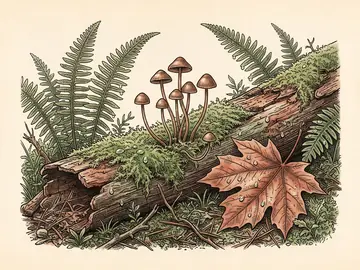 The psilocybin mushrooms named in the Pacific NorthwestWho named the region's psilocybin mushrooms, when and from where, and the deadly amatoxin lookalikes.
 A history of magic mushrooms in SeattleFrom a 1964 mushroom society and a species named on the UW campus to the city and county votes of 2021 to 2026.
 Psilocybin in Seattle and Washington: a dated timeline, 1937 to 2026140 dated events from 1937 to 2026: the law, the science, the research and the culture, each with its source.
Compiled and checked by the Magic Mushrooms Seattle editors. Every fact on this page is dated and links to its source. Found an error? Tell us and we'll correct it in the open, as our editorial standards describe. Magic Mushrooms Seattle is published by the team that runs My Mushroom Dispensary, an online shop. We sell no advertising and nothing on this site.